
Shrubs form the structural backbone of most gardens, and in cold climates their selection deserves particular attention. Unlike herbaceous perennials that disappear in winter, shrubs remain visible year-round. In Polish conditions, this means their winter silhouette, stem colour, and berry retention matter as much as summer flowering. This article focuses on species with published hardiness ratings below −15°C (broadly zone 5 and colder) and, where possible, documented performance records in Polish or comparable continental European gardens.
Cornus (Dogwoods) — Stem Colour and Cold Hardiness
Cornus alba (Tatarian dogwood) and its cultivars are among the most reliably hardy shrubs for Polish gardens. C. alba is rated zone 2–3 in most reference databases, meaning it tolerates temperatures well below those typical of the coldest Polish winters. The key winter feature is vivid red stem colour, most intense on stems grown in the previous season. This makes annual or biennial hard pruning in early spring the standard management approach.
Cultivar 'Sibirica' has particularly intense crimson stems and is frequently cited in Polish horticultural literature as performing well across all lowland zones. 'Elegantissima' (variegated foliage) and 'Aurea' (yellow-green leaves) offer additional interest in other seasons without sacrificing winter hardiness. Cornus sericea 'Flaviramea' provides yellow stems as a contrast to red-stemmed cultivars and is equally cold-hardy.
Pruning Note
Hard pruning (cutting to approximately 10–15 cm above ground) in early spring, before buds break, maximises new stem production and therefore winter colour. Leaving shrubs unpruned for several years results in increasingly poor stem colour as the proportion of mature wood increases. Many Polish gardeners prune alternate halves in consecutive years to maintain some size and structure while still producing colourful young wood.
Rosa rugosa — Structural Rose for Severe Conditions
Rosa rugosa is one of the few roses consistently described as truly hardy through Polish winters without protection. It is rated zone 2–3. Its natural range includes northeastern China, Korea, and coastal Japan, where winter temperatures are comparable to or colder than Poland. It tolerates poor, sandy soils and coastal conditions, and the large orange-red hips persist into winter, providing food for birds and visual interest through January.

In practice, R. rugosa's vigorous spreading habit makes it better suited to informal planting, hedges, or large borders than formal rose beds. It naturalises readily and can become invasive in sandy soil conditions — a consideration in some Polish coastal and heathland areas where it is documented as an invasive species in natural habitats. In cultivated garden settings it is manageable with annual pruning.
Erica carnea — Winter Flowering Heath
As noted in the companion article on frost-resistant plants, Erica carnea is the only heath species reliably documented as tolerating alkaline soils in addition to zone 5 cold. It flowers from January through April in most Polish conditions, making it one of very few shrubs with consistent winter colour in difficult conditions.

Multiple cultivars span a flowering season from November to May, and colour ranges from white through pink to deep magenta. 'Springwood White' (January–March) and 'Vivellii' (February–April, deep carmine) are among the cultivars most consistently cited in central European garden literature. Plant in well-drained soil in full sun to part shade. Shear lightly after flowering to maintain compact form — hard pruning into old wood should be avoided.
Jasminum nudiflorum — Winter Jasmine
Winter jasmine is a wall shrub that produces small yellow flowers on bare green stems from November through March, flowering before any foliage appears. It is rated hardy to zone 6, placing it at the margin for colder Polish regions, but in sheltered south- or west-facing positions it is documented as reliably flowering through mild periods of central Polish winters.
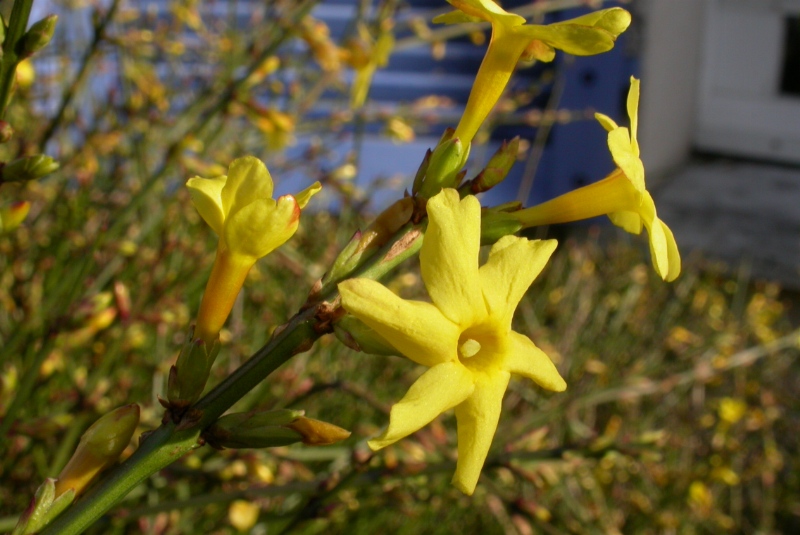
It is not a climber in the strict sense — it does not self-attach. The long arching stems require tying to a support or wall. Pruning after flowering (March–April) removes flowered stems and encourages new growth. In exposed positions below zone 6 it may suffer stem tip dieback in severe winters but typically regenerates from lower wood.
Clematis alpina — Early Hardy Clematis
Clematis alpina is native to alpine regions of Europe and Asia and is one of the hardiest clematis species, rated zone 4–5. It produces nodding blue, purple, or white flowers in April–May, earlier than most clematis, and decorative seed heads through summer and autumn. It is a small-growing clematis (2–3 m) more suited to growing through shrubs or on low trellises than to covering large areas.

In contrast to large-flowered hybrid clematis, C. alpina requires minimal pruning — removing dead or weak stems after flowering is sufficient. It is documented in multiple Polish garden collections without additional winter protection.
Comparative Summary
Hardiness comparison of shrubs covered in this article:
- Cornus alba — Zone 2–3. No protection needed. Prune annually for stem colour.
- Rosa rugosa — Zone 2–3. No protection needed. Spreading habit requires management.
- Erica carnea — Zone 5–6. No protection in most of Poland. Full sun, well-drained soil.
- Jasminum nudiflorum — Zone 6. Needs sheltered position in northern/eastern Poland.
- Clematis alpina — Zone 4–5. Reliable without protection. Minimal pruning.
References
Species hardiness data from RHS Plant Finder and Plants for a Future (PFAF). Climate data from IMGW.
Article last updated: October 2024